Our Publications & Research Initiatives
The Centre for Sustainable Innovation is committed to advancing knowledge and driving meaningful change through rigorous research, collaborative partnerships, and evidence-based practice. This page showcases our latest publications, research projects, thought leadership, and innovation initiatives, highlighting the work we undertake to address complex sustainability challenges and create lasting social, environmental, and economic impact.
The publications presented here are organised into four interconnected themes: Sustainability, Digital Transformation, Change Management, and Ecosystems.
Energy; Pages: 141 – 191
This research evaluates two approaches to improving biogas production from paper sludge: hydrothermal pretreatment and microbial acclimation. While pretreatment increased methane yields by 15–22%, its high energy requirements resulted in a negative net energy gain. In contrast, acclimated microbial communities delivered significantly higher methane production without additional energy input and improved long-term process stability. The findings demonstrate that microbial adaptation is a more effective, sustainable, and scalable strategy for converting paper sludge into renewable energy.
Ozgun Ceren Avincsal
Erik Christopher Hallsworth
Dr Zaenab Abd-Allah
Sean Brierley
Mayri Alejandra Diaz De Rienzo
Rosa Arrigo
Silvia Tedesco
Waste and Biomass Valorization; Pages: 4813 – 4831
This study investigates the use of corrugated cardboard fly ash (CCFA), an industrial by-product, as a sustainable component in low-carbon cementitious binders. Findings show that while CCFA alone reduces compressive strength, combining it with metakaolin can achieve performance comparable to conventional cement blends. The research highlights the potential of CCFA to reduce cement use, support waste valorisation, and contribute to more sustainable construction materials.
Erik Christopher Hallsworth
Levingshan Augusthus-Nelson
Sergio Davies
Aron Teklemariam
Lubomira Tosheva
Silvia Tedesco

International Journal of Thermofluids; Pages: 101 – 175
This review examines the production of levulinic acid from lignocellulosic biomass, highlighting advances in catalytic processes that improve yields and support sustainable biorefinery development. It also explores the potential of solid by-products, particularly hydrochar, for enhancing anaerobic digestion and increasing methane production. The paper identifies key research gaps and presents new insights into biomass valorisation, circular economy approaches, and low-carbon chemical production.
George Hurst
Aron Teklemariam
Sean Brierley
Mayri Alejandra Diaz De Rienzo
Silvia Tedesco

Cleaner Production Letters
This paper examines how information and knowledge sharing can support circular economy principles in construction procurement. Through a systematic literature review, it identifies barriers, enablers, research gaps, and knowledge-management practices across procurement stages. It proposes a construction-specific framework and recommends further research on organisational behaviour, policy, technology, and skills development.
Stephen Kelly
Dimitra Kalaitzi
Aaron Robertson
Yiannis Polychronakis
Business Horizons
This paper explores how SMEs can manage the cybersecurity and governance challenges associated with rapid AI adoption. Drawing on a UK government-funded intervention involving 400 SMEs in Greater Manchester, it provides seven practical insights to help businesses strengthen AI-cyber readiness. The findings show that effective AI governance is not simply a technical issue but an evolving managerial capability, and highlight how accessible, low-burden support can help SMEs adopt AI securely, responsibly, and with greater confidence.
Yun Chen
Angel Jimenez-Aranda
Mirage Islam
Tarek Gaber
AI Security in Contactless Payments and Education: A Review (2025)
Journal of Engineering Education Transformations; Pages: 20 – 25
This paper examines the cybersecurity risks facing contactless payment systems in an increasingly AI-driven digital economy. Focusing on threats such as adversarial machine learning, ransomware, and vulnerabilities in NFC technologies, it evaluates emerging AI-based defence strategies and their practical limitations. The study also highlights the importance of integrating AI security, embedded systems, and threat modelling into computer engineering education, offering recommendations for securing future contactless payment ecosystems.
Ahmed Hamed
Yojna Bansal
Mostafa Mohamad
Angel Jimenez-Aranda
Tarek Gaber
A Framework for Building a Secure, Resilient and AI-based Digital Future for SMEs (2025)
Proceedings of the 2nd International Workshop on Education for Artificial Intelligence (ECAI 2025)
This paper presents a novel framework to help SMEs adopt artificial intelligence securely and responsibly while strengthening their cybersecurity resilience. Addressing AI’s dual role as both a cybersecurity enabler and a potential source of new vulnerabilities, the framework combines technical, organisational, and behavioural approaches to improve preparedness against emerging threats. It also promotes greater diversity in AI and cybersecurity by encouraging the participation of women in STEM. The research provides practical guidance to support secure AI adoption and enhance SME resilience.
Angel Jimenez-Aranda
Tarek Gaber
Yun Chen
Mirage Islam
Adversarial-aware Machine Learning for Enhancing Smart Grid Security (2024)
2024 25th International Middle East Power System Conference (MEPCON)
This study presents an adversarial-aware intrusion detection system for smart grids that enhances resilience against label flipping attacks, a form of data poisoning that can compromise machine learning models. Using the University of Queensland ICS cyber-attack dataset, the research evaluates multiple algorithms and demonstrates how a targeted countermeasure can restore model performance under attack conditions. The findings highlight Random Forest as the most robust approach and underscore the importance of defensive machine learning strategies for protecting critical energy infrastructure from evolving cyber threats.
Yusuf Ademola Sodiq
Tarek Gaber
Reham Amin
Angel Jimenez-Aranda
Mohamed Galeela
A Decade of Data: A Journey of Change and Organisational Culture in UK Businesses (2026)
Occupational Psychology Outlook; Pages: 14 – 23
This study evaluates the Cultural Change Readiness Survey (CCRS), a tool designed to assess organisational culture and change readiness in UK SMEs. Analysis of 2,150 responses collected over 12 years confirmed its reliability and validity, with strengths identified in relationships, key tasks, and performance. Leadership, motivation, and attitudes to change showed greater variation, including a notable decline in motivation after 2022, highlighting the value of ongoing cultural assessment in supporting organisational change.
Sarah Clarke
Ann Mulhaney
Steph Durbin
A Human-Centric Approach to Digital Transformation (2024)
Research and Innovation Forum 2024; Pages: 621 – 634
This study explores the development of a digital skills portal to support Greater Manchester SMEs in adopting digital technologies and improving workforce digital capabilities. Using interviews and focus groups, the research identified key barriers to technology adoption, including limited strategy, skills gaps, cost, time constraints, and staff attitudes. The proposed platform combines business transformation resources with digital skills training and AI-enabled learning tools, offering practical solutions to enhance technology adoption, productivity, and regional economic competitiveness.
Ann Mulhaney
Prof. Mandy Parkinson
Dr Anisa Kabir Abdulfatah
Research and Innovation Forum 2024; Pages: 723 – 737
This study examines digital technology adoption in micro-businesses (MBs), a vital yet under-researched segment that represents the majority of UK businesses. It highlights how management limitations and business owner attitudes can hinder effective technology adoption, often leading to ad hoc implementation and underutilisation of digital tools. The research investigates the extent to which business owners influence digital adoption success, aiming to address gaps in understanding the unique challenges faced by micro-businesses.
Prof. Mandy Parkinson
Ann Mulhaney
Faran Ahmed
The Death of Business as Usual: The Impact of VUCA on the sustainability of SME’s (2023)
Research and Innovation Forum: Navigating Shocks and Crises in Uncertain Times, Technology, Business, Society; Pages: 65 – 83
This paper explores how small and medium-sized enterprises (SMEs) can navigate increasingly volatile, uncertain, complex, and ambiguous (VUCA) environments shaped by globalisation, technological change, demographic shifts, and environmental pressures. Through a review of literature on leadership, innovation, technology, and organisational learning, the study identifies key areas of convergence that support business resilience and sustainability. The findings provide an evidence-based foundation for developing practical tools and strategies to help SME leaders adapt, innovate, and thrive in an increasingly unpredictable business landscape.
Neil Simpson
Ann Mulhaney
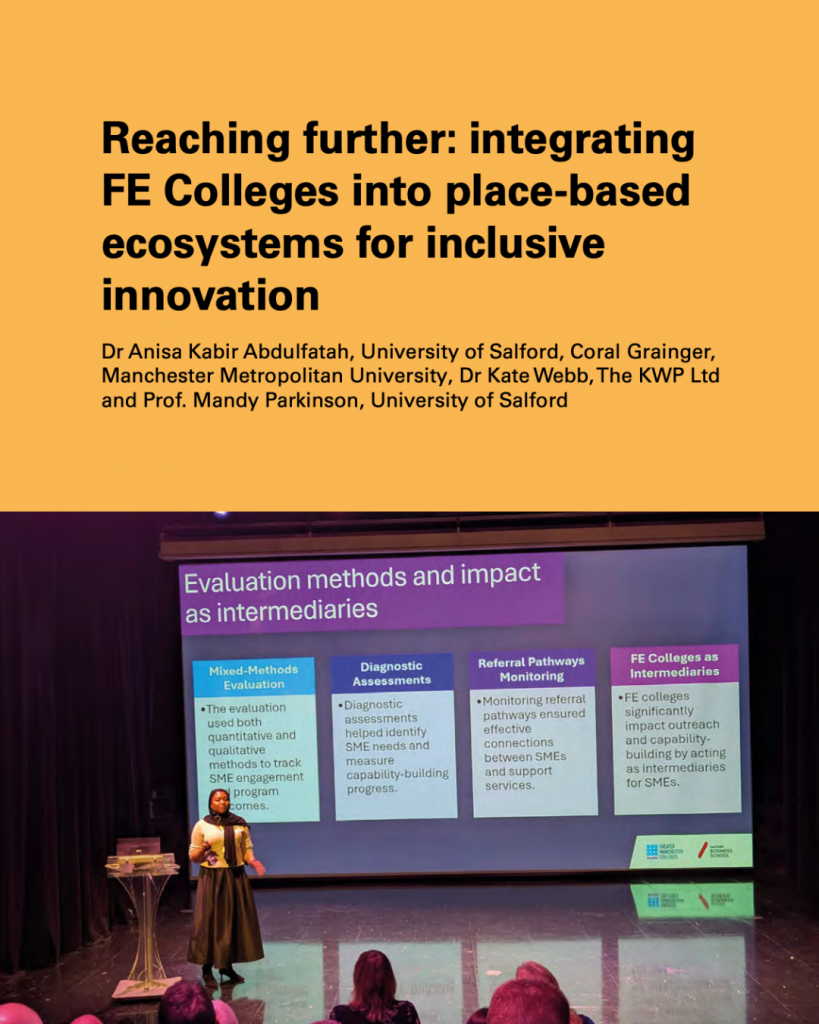
iPLACE Innovation Ecosystems; Pages: 173 – 196
This research explores the role of Further Education (FE) colleges within regional innovation ecosystems, drawing on evidence from the Greater Manchester Further Education Innovation Programme (GMFEIP). The findings highlight how FE colleges act as embedded innovation intermediaries, connecting SMEs, learners, and communities to innovation opportunities. The study argues that FE colleges play a vital role in promoting inclusive, place-based innovation and should be strategically integrated into regional governance frameworks as core civic and knowledge partners.
Dr Anisa Kabir Abdulfatah
Dr Kate Webb
Prof. Mandy Parkinson
Innovation “from the outside in” – rethinking regional ecosystems (2026)
i-PLACE Innovation Ecosystems; Pages: 91 – 109
This paper explores how the MediaCity Immersive Technology Innovation Hub (MITIH) supports SME innovation in Greater Manchester. Using Actor-Network Theory, it demonstrates how MITIH brings together businesses, technology, expertise, infrastructure, and funding to create collaborative innovation networks. The research argues that accelerators are more than structured programmes; they are place-based, socio-material platforms that enable coordination, knowledge exchange, and innovation. Findings highlight MITIH’s effectiveness in engaging SMEs and its role as a key catalyst within the regional innovation ecosystem.
Prof Nic Beech
Prof Mandy Parkinson
Prof Katy Mason
Dr Anisa Kabir Abdulfatah

Demystifying Circular Purchasing: Toward a New Procurement Paradigm – IPSERA 2025
IPSERA 2025
This paper argues that procurement can play a key role in advancing the circular economy by moving beyond traditional cost-focused purchasing. It clarifies the concept of circular purchasing, highlights barriers to adoption, and proposes frameworks that integrate reuse, repair, remanufacturing, and resource efficiency into procurement decisions. The authors emphasize the need for new skills, collaboration, and organizational change to help purchasing functions support long-term sustainability and value creation.
Vojtech Klézl
Stephen Kelly
Johan Kask
Aaron Robertson
Embedding circularity processes, skills and knowledge in housebuilding procurement (2026)
IPSERA 2026
This paper makes progress towards developing a conceptual model that integrates circular economy principles with organisational business processes in the context of construction and housebuilding. Despite increasing interest in circularity, the sector has demonstrated limited progress due to its reliance on project-based delivery models, which can restrict the integration of circular practices across supply chains and build lifecycles. Following semi-structured interviews three key themes were identified: systems approaches, supply chain structures, and organisational processes. Drawing on circular economy frameworks and circular business model strategies the paper illustrates how changes to these thematic areas may enable greater adoption of circular approaches within housebuilding and construction contexts.
Vojtech Klézl
Aaron Robertson
Stephen Kelly
EurOMA 2024 Annual Conference
This case study examines how knowledge sharing supports the implementation of circular procurement in the construction industry. It highlights the importance of collaboration, communication, and learning among stakeholders to overcome barriers to circular economy practices. The study identifies key mechanisms for transferring knowledge across supply chains and projects, showing how improved knowledge management can enhance procurement decisions, increase resource efficiency, and support the transition toward more sustainable and circular construction practices.
Dimitra Kalaitzi
Aaron Robertson
Stephen Kelly
Yiannis Polychronakis
Work With Us
The Centre for Sustainable Innovation actively collaborates with businesses, public sector organisations, researchers, and communities to address complex sustainability challenges. If you are interested in partnering on research, innovation projects, or knowledge exchange activities, we would be delighted to hear from you.

Let’s start your journey towards sustainability and growth.
Interested in working with the CSI but don’t know where to start? Fill in the inquiry form here